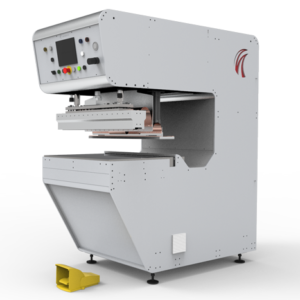
Welding machines

Frequently asked questions about welding machines

What is often misleadingly referred to as “plastic welding” is a set of methods used to glue or bond plastic parts, components and other substrates. Increasingly widespread in industry due to the ubiquity of thermoplastics and the proliferation of packaging, welding machines can be used to assemble tubes, profiles, blocks, sheets, tarpaulins, films, covers or foils.

What processes are used for the various welding machines?

Various processes can be used to assemble plastic components using a welding machine. They are all based on heating thermoplastic materials to produce welds in an industrial environment.

Hot gas or hot blade welding

When using these two welding techniques, the individual components are joined solely by heating. The hot-gas welding process involves adding material with a small-diameter PVC rod, to enable the two parts to be bonded together. The use of a flashlight enables heating to be carried out without the material coming into direct contact with the material. Welding with heated blades is generally carried out with dedicated equipment, enabling much greater welding precision. Heated mirrors or blades are placed between the layers to be joined to heat them up. Once these are sufficiently hot, the blades are removed and the parts sealed. These two processes, applied to plastics in this way, can also be used to join metals such as aluminum or steel, depending on the thickness of the metal.

Linear or rotary friction welding

The processes in question involve applying high pressure to the plastic parts to be joined, in order to weld them together. To speed up the process, it is also possible to add heating to the zones in contact. To ensure the strength of this joint, or to complete it with new layers of material, additional pressure is applied during assembly. The application of the linear friction process simply requires the use of a specialized press. For rotary friction, the press must operate at high speed, with two surfaces to be welded under tension and very close together. This causes localized heating, leading to melting of the surfaces in question.

Ultrasonic or high-frequency welding

Both processes are based on internal rather than external heating of the materials to be welded. The operation of high-frequency and ultrasonic presses is based on a platen to support the material under tension and an electrode. These electrodes cause molecules to vibrate on a very small scale, either by waves (ultrasound) or by an electromagnetic field (high-frequency), thus heating the material from the inside to the surface. These latest plastic welding processes are based on the latest, most efficient technologies. In fact, they produce more precise welds and more meticulous work than other processes.

What materials can be joined using a welding machine?

The oldest and most frequently practised types of welding concern the assembly of metal elements and ferrous and non-ferrous alloys. For this purpose, the most widely used equipment is the arc welder, based on a fairly simple and already ancient technology.
This equipment can be used to assemble the following metals and alloys:

  • aluminum,
  • steel,
  • stainless steel,
  • copper,
  • zinc.

However, given the evolution of plastics technology, there are more parameters to take into account. Some plastics do not deform when heated: these are called thermosets. Even so, they are still in the minority among the plastics we use every day. Others, called thermoplastics, can be shaped at high temperaturesand thus welded. The most common thermoplastics are polystyrene, polyethylene (PE), PVC, polypropylene (PP), polyamides (PA), some EVA sheets and polyurethanes (PU).

In some cases, it may be possible to weld several parts of different plastics that are close in thickness (or diameter) and level of rigidity. This also depends on the molecular composition and organization of the two elements, which must be compatible for a durable joint. If conditions are optimal, choosing different plastics can make the weld stronger than with identical materials. Manufacturers often offer a varied catalog of welding machines, based on their own range and the brands they distribute. This makes it possible to meet the expectations of industrialists in terms of working precision, machine operating speed or capacity for assembling large-format parts.

Are welding machines easy to use and maintain?

When it comes to getting to grips with the machine, training is always provided by the manufacturer or distributor, along with an annual user manual or technical documentation. In the range of plastic welding machines available, most are easily parameterized via their man-machine interface in the form of a control panel. To ensure optimum production, welding machines require both preventive and corrective maintenance. The former is generally covered by an equipment maintenance contract, while the latter is provided by the manufacturer’s after-sales service.